The Sorting Machine
Election-day notes on what the newest experiments say about feeds and tribes
Mitchell McLennan
Founder · Wavestar Holdings · November 3, 2026 · 4 min read
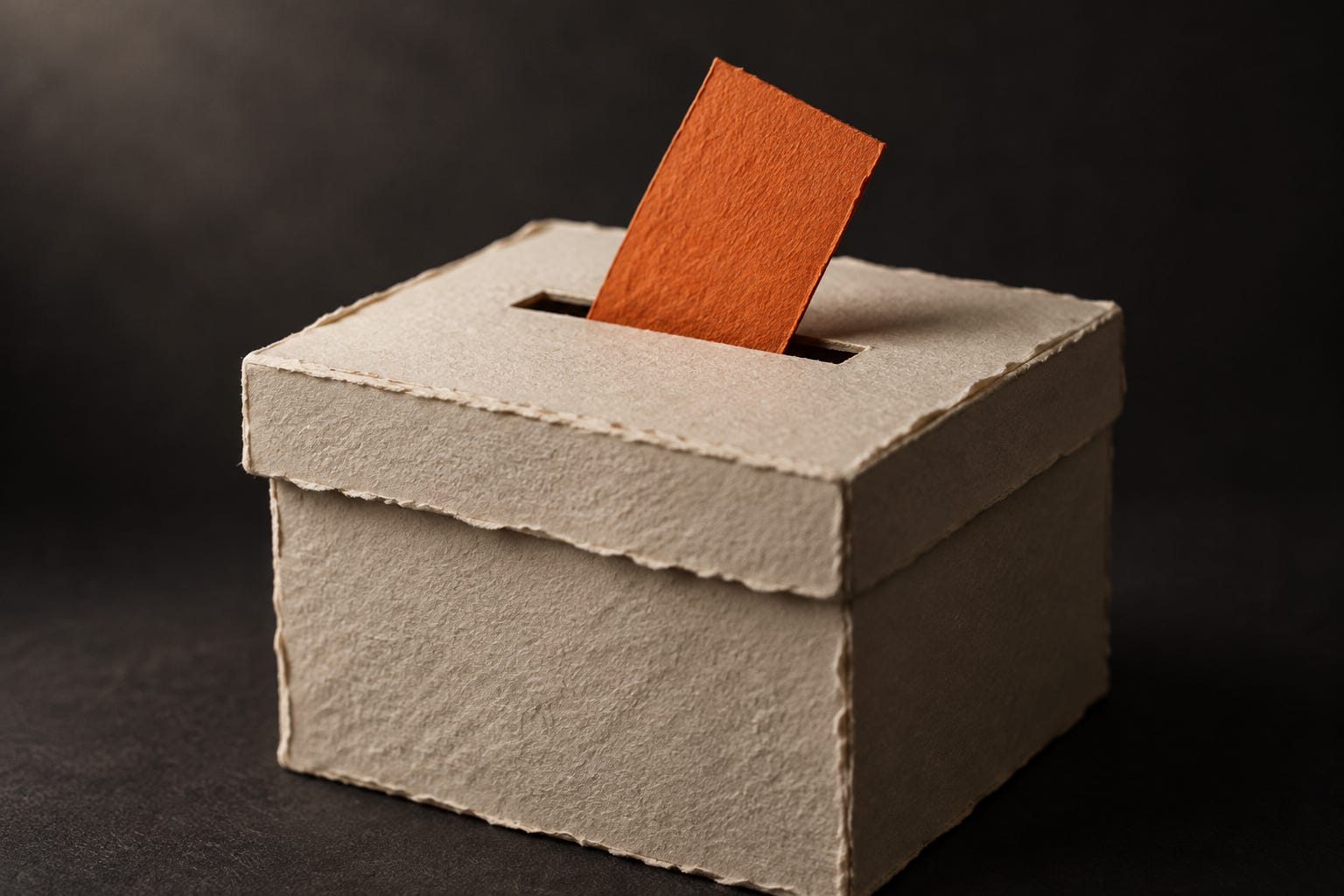
Today, November 3, 2026, Americans vote. Four hundred and seventy seats in Congress are on the ballot, and for a few hours the country's political life happens in school gyms, on paper, behind curtains. The rest of the year it happens in feeds. Everyone knows the story of what the feeds have done to us. The story is worth examining, because the best recent evidence says the story is wrong in an interesting way.
The conventional account runs cleanly. The platform optimizes for engagement. Outrage engages. Therefore the platform manufactures tribes. There is real evidence under the hood: in a 2017 PNAS study of more than half a million tweets about gun control, same-sex marriage, and climate change, William Brady and colleagues found that each additional moral-emotional word in a message raised its diffusion by about twenty percent on average, and the effect ran mostly within ideological groups rather than between them. The feed pays a bounty for the language of us-against-them, and the us and the them arrive pre-sorted. From there it is a short walk to the conclusion that the machine made us this way.
The strongest causal tests have been unkind to that conclusion. In 2017, Levi Boxell, Matthew Gentzkow, and Jesse Shapiro found that American polarization had grown fastest among people over sixty-five, the demographic least likely to be online at all; their estimate assigns the internet a small share of the increase. In 2020, in the largest experiments ever run inside a platform, academic researchers working with Meta moved consenting users to reverse-chronological feeds for the election season. Nearly everything measurable about what those users saw changed: time on platform, exposure to untrustworthy sources, the civility of the diet. What they felt did not move. Three months of chronological feeding produced no significant change in affective polarization or issue positions, though the finding carries a caveat: Meta quietly altered its own algorithm dozens of times during the study, which critics argue muddied the control condition.
Then the newest evidence cut back the other way, and it is harder to dismiss. In a preregistered experiment published in Science in November 2025, Tiziano Piccardi and colleagues used a browser extension to rerank the feeds of 1,256 people on X in the weeks before the 2024 presidential election, pushing hostile and antidemocratic content up for some participants and down for others. One week of reranking moved feelings toward the opposing party by more than two degrees on a hundred-point thermometer, in both directions, with no detectable difference between liberals and conservatives. The authors note the induced swing rivals roughly three years of background drift in American polarization. A second preregistered experiment, published in Nature in May 2026, put two thousand participants on custom-built feeds for eight weeks around the same election: an engagement-optimized ranking amplified moralized, emotional, and toxic content and raised perceived partisan animosity relative to a chronological feed, even though users' own behavior did not measurably change. A redesigned ranking that diluted the loudest voices cut the toxic exposure without costing the platform any enjoyment.
The ledger, read carefully, convicts both camps. The machine is neither innocent nor omnipotent. Tribalness predates the feed by decades: in 1960 about five percent of partisans said they would be displeased if their child married across party lines, and by 2010 the figure was nearly half of Republicans and more than a third of Democrats, most of that movement accomplished before the algorithmic timeline existed. The feed did not invent the tribe. What it did was discover that animosity is billable. It made tribalness legible, sortable, and chargeable by the impression, and it turned belonging from a biennial errand into a daily subscription.
That is the mechanism the outrage story misses. The feed's deepest effect is coordination rather than persuasion: it tells each side, continuously and at scale, what its own side thinks. A tribe runs less on shared beliefs than on a constantly refreshed knowledge of where the borders are. Once you see the product as border maintenance rather than brainwashing, both sets of results make sense. Three months of chronological order could not dissolve borders the ranking never drew. One week of reranked animosity could move the thermometer, because what moves people is the perceived temperature of the other tribe.
There is a consolation buried in the new experiments, though it is not a comfortable one for anyone. The same studies that convict the machine also show it can be tuned down inside a week, without anyone logging off, by people who simply choose different dials. The question was never whether ranking matters. The question is who the ranking is for, and the only honest answer at the moment is that it is for the meter. Today belongs to the older technology. The ballot is the one feed the algorithm cannot rerank: one person, one curtain, no metrics. The feed will be there tomorrow, optimized as ever. The booth will not.
Sources:
• USPS Postal Bulletin, "Key Elections" (2026), for the November 3, 2026 general election and the 470 congressional seats. (https://about.usps.com/postal-bulletin/2026/pb22694/html/cover_004.htm)
• W. Brady, J. Wills, J. Jost, J. Tucker, J. Van Bavel, "Emotion shapes the diffusion of moralized content in social networks", PNAS (2017), for the twenty-percent-per-word diffusion figure and the within-group bounding. (https://www.pnas.org/doi/10.1073/pnas.1618923114)
• L. Boxell, M. Gentzkow, J. Shapiro, "Greater Internet use is not associated with faster growth in political polarization among US demographic groups", PNAS (2017), for the over-65 finding. (https://www.pnas.org/doi/10.1073/pnas.1706588114)
• A. Guess et al., "How do social media feed algorithms affect attitudes and behavior in an election campaign?", Science (2023), for the chronological-feed null result, including the published eLetter exchange on Meta's mid-study algorithm changes. (https://www.science.org/doi/10.1126/science.abp9364)
• T. Piccardi et al., "Reranking partisan animosity in algorithmic social media feeds alters affective polarization", Science (November 27, 2025), for the X reranking experiment. (https://www.science.org/doi/10.1126/science.adu5584)
• "Redesigning algorithms to intervene on social norm misperceptions during a national election", Nature (May 27, 2026), for the eight-week custom-feed experiment. (https://www.nature.com/articles/s41586-026-10536-1)
Originally published on
mitchellmclennan.substack.com

